
Email Marketing for Long-Term Success
Table Of Contents
- Email marketing challenges affecting business growth
- Understanding importance of email marketing today
- Proven email marketing strategies for success
- Advanced solutions for scalable email campaigns
- Email marketing tools and methods comparison
- Email marketing pros and cons overview
- Best suited email marketing use cases
- Top strengths of effective email campaigns
- Common limitations in email marketing strategies
- Market comparison of leading email platforms
- Email marketing trends and changes in 2026
- Building trust through reliable email practices
- Decision making guide for email strategies
- Taking action for long term email success
- Conclusion
- FAQs
Email marketing remains one of the most powerful and affordable digital channels for businesses of all sizes. This blog covers key challenges like deliverability and engagement, proven strategies including segmentation and automation, top platform comparisons, emerging 2026 trends like AI personalization and interactive emails, and practical guidance on choosing tools, Planning Budgets, and Scaling Sustainably for Long-Term Growth.
Email marketing challenges affecting business growth
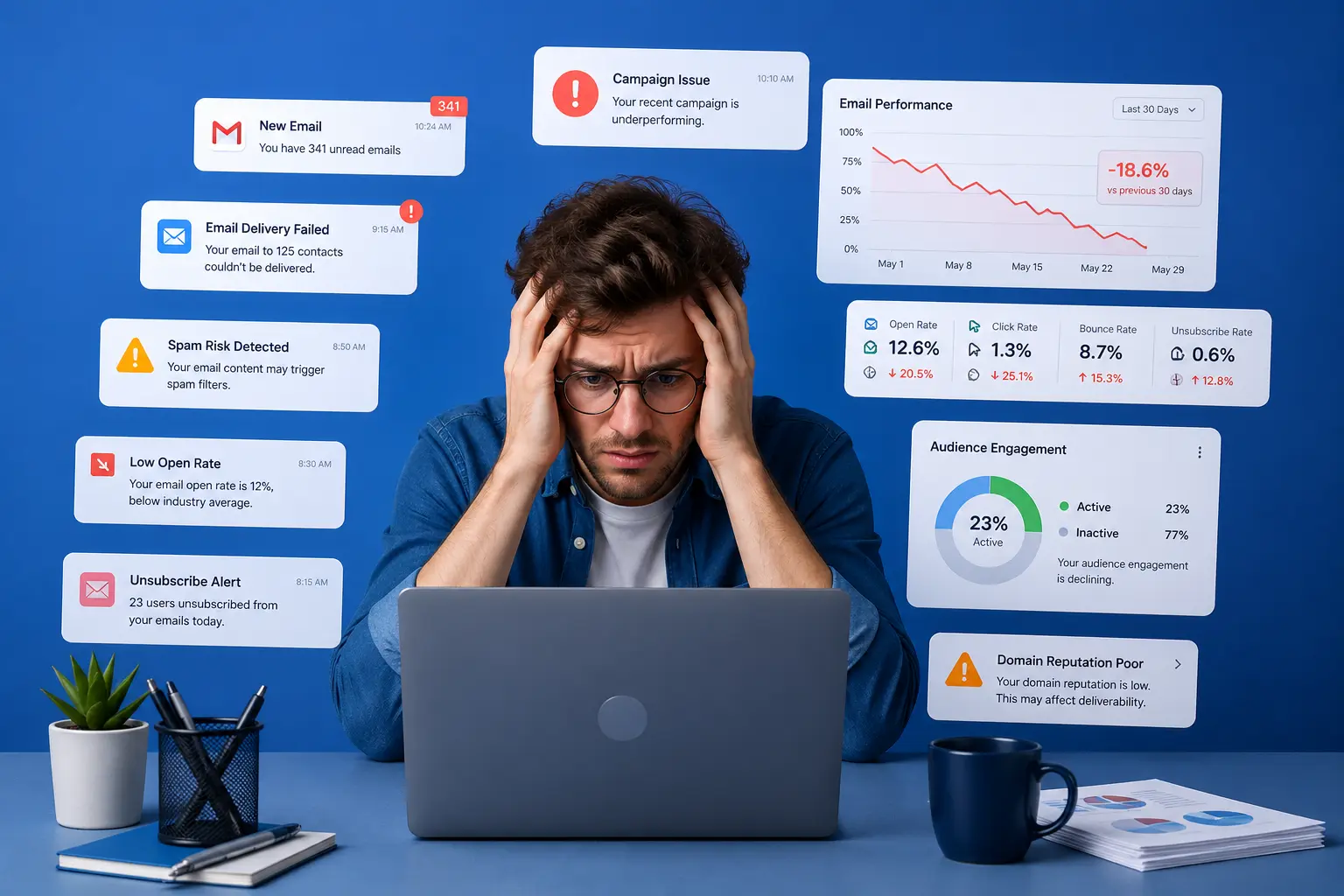
Troubleshooting Email Marketing – Performance Issues and Alerts
Email marketing remains one of the most cost-effective digital channels, yet many businesses struggle to unlock its full potential due to persistent operational and strategic challenges. From technical deliverability issues to shifting consumer behaviors, these obstacles directly limit campaign performance, suppress revenue growth, and weaken the overall marketing ROI that businesses depend on for scale.
Declining engagement rates across inbox competition
With the average professional receiving over 120 emails per day, standing out in a saturated inbox has become increasingly difficult for marketers. Declining open rates and click-through rates signal a deeper problem - audiences are overwhelmed, and brands that fail to deliver relevance, timing, and value consistently find themselves ignored or unsubscribed, undermining long-term list health and campaign effectiveness.
Poor deliverability impacting campaign performance
Even the most brilliantly crafted email campaign is worthless if it never reaches the intended recipient's inbox. Poor sender reputation, misconfigured authentication protocols like SPF, DKIM, and DMARC, and high bounce rates collectively push emails into spam folders, severely limiting campaign reach and wasting marketing budgets that could otherwise be driving measurable business results.
Ineffective targeting reduces conversion opportunities
Sending the same generic message to an entire subscriber list is one of the most common and costly email marketing mistakes businesses make. Without meaningful audience segmentation and behavioral data integration, campaigns fail to align with where individual subscribers are in the buying journey, resulting in lower conversion rates, higher unsubscribe rates, and missed revenue that precision targeting could have captured.
Understanding importance of email marketing today
In an era dominated by algorithm-driven social media platforms and increasingly expensive paid advertising, email marketing stands out as a uniquely reliable and owned communication channel. Businesses that invest in building and nurturing their email lists are creating long-term assets that generate compounding returns, independent of third-party platform changes or rising ad costs that continue to squeeze digital marketing budgets.
Building direct communication with target audiences
Unlike social media platforms that control organic reach through ever-changing algorithms, email gives businesses a direct, unfiltered line to their audience's inbox. This direct access allows brands to communicate promotional offers, product updates, and educational content on their own terms and schedule, establishing a consistent presence that builds familiarity, trust, and a stronger likelihood of conversion over repeated touchpoints.
Strengthening brand loyalty through consistent messaging
Brands that show up consistently in their subscribers' inboxes with value-driven, relevant content build a level of familiarity that translates directly into customer loyalty and repeat purchases. Regular email communication reinforces brand identity, keeps products and services top of mind, and creates a sense of ongoing relationship that social media posts or one-time ad impressions simply cannot replicate over the customer lifecycle.
Driving long term revenue with email strategies
Email marketing consistently delivers one of the highest returns on investment of any digital marketing channel, with industry benchmarks frequently citing $36 to $42 in revenue for every dollar spent. When powered by strategic segmentation, lifecycle automation, and personalized content, email becomes a sustainable revenue engine that grows alongside the business, generating predictable income from existing customers while continuously converting new subscribers into buyers.
Proven email marketing strategies for success
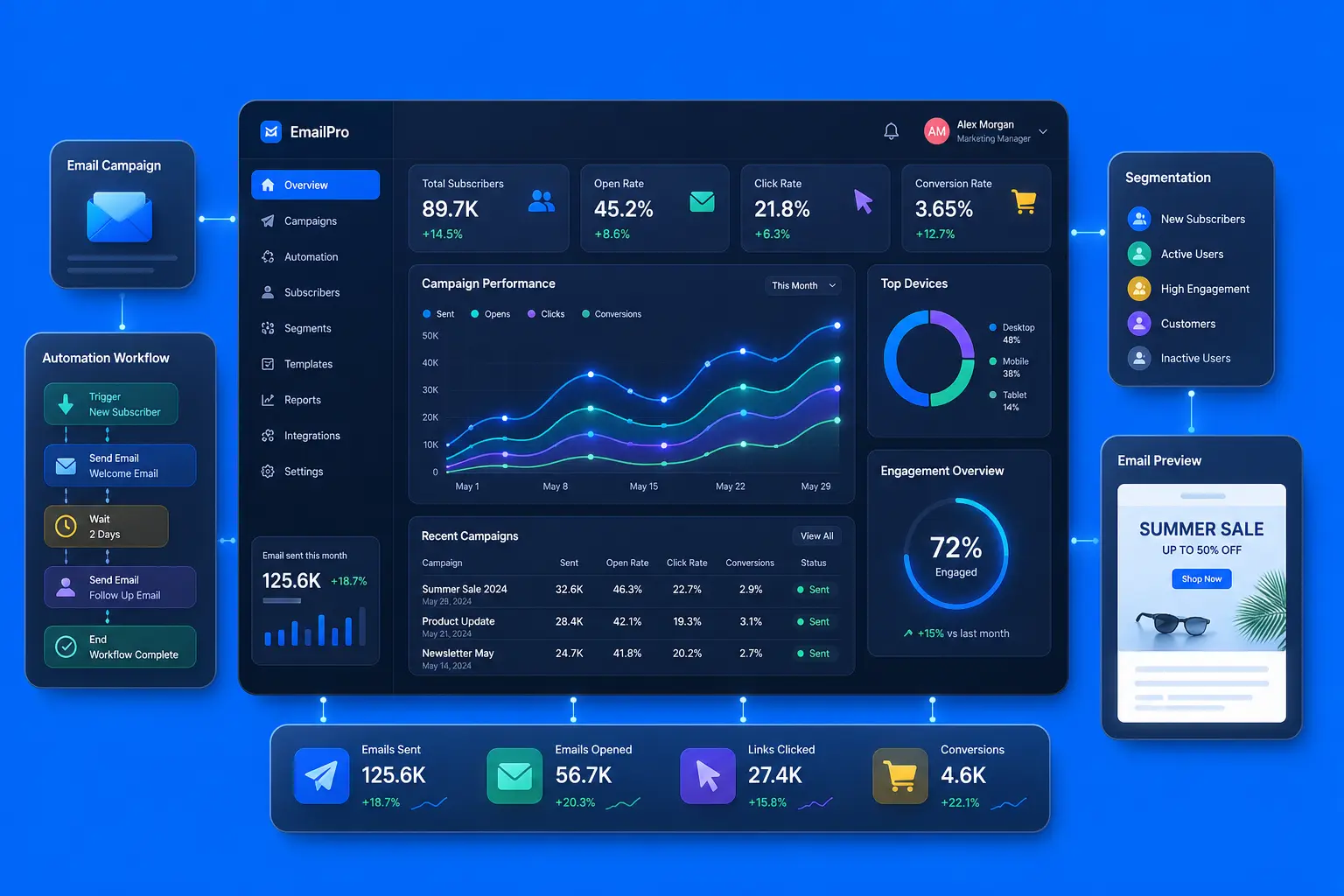
How Top Brands Win with Email – Performance Dashboard Overview
Achieving consistent results in email marketing requires moving beyond basic broadcast campaigns and adopting strategies rooted in data, personalization, and automation. Businesses that implement proven frameworks for segmentation, behavioral targeting, and automated workflows consistently outperform competitors who rely on manual, one-size-fits-all approaches - achieving higher engagement, better deliverability, and stronger revenue outcomes across every stage of the customer journey.
Personalization techniques improving user engagement rates
Personalization in email marketing extends far beyond addressing subscribers by their first name - it encompasses dynamic content blocks, purchase-based product recommendations, behavior-triggered messaging, and send-time optimization tailored to individual engagement patterns. Campaigns that leverage deep personalization see significantly higher open rates, click-through rates, and revenue per email because recipients receive content that feels genuinely relevant to their specific needs and interests at that moment.
Segmentation methods for targeted campaign delivery
Effective email segmentation means dividing your subscriber list into meaningful groups based on demographics, purchase history, geographic location, engagement level, and stage in the sales funnel. For example, a SaaS company might send a feature tutorial series to new trial users while sending an upsell campaign to power users who have reached usage limits - ensuring that each segment receives messaging that aligns precisely with their current relationship with the brand.
Automation workflows saving time and increasing efficiency
Email automation workflows allow businesses to deliver the right message at exactly the right moment without requiring manual intervention for every send. Welcome sequences, cart abandonment reminders, post-purchase follow-ups, re-engagement campaigns, and anniversary emails can all be configured once and run continuously, saving significant team time while consistently nurturing leads and customers through every critical stage of the buying journey.
Advanced solutions for scalable email campaigns
As businesses grow and subscriber lists expand into the hundreds of thousands, managing email campaigns manually becomes unsustainable and inefficient. Scaling email marketing effectively requires adopting enterprise-grade tools that combine artificial intelligence, rich behavioral data, and cross-channel integration to automate complexity, maintain personalization at scale, and continuously optimize campaign performance without proportional increases in team resources or operational overhead.
AI powered tools enhancing campaign performance
Artificial intelligence is fundamentally transforming how email marketers approach content creation, send-time optimization, and predictive audience segmentation. AI-powered platforms can analyze millions of behavioral data points to predict which subscribers are most likely to convert, automatically test subject line variations, and dynamically adjust email content based on real-time engagement signals - delivering measurable improvements in open rates, conversion rates, and overall campaign ROI with far less manual effort.
Data driven insights optimizing email marketing results
Making decisions based on gut instinct rather than data is one of the primary reasons email campaigns underperform their potential.Contemporary email solutions deliver detailed insights into open rates, click behavior, conversion tracking, customer lifetime worth, and campaign-driven revenue - enabling marketers with practical data to consistently enhance content, scheduling, layout, and targeting methods that steadily boost overall business performance across repeated campaign cycles.
Omnichannel integration improving customer journey experience
Email marketing performs at its highest level when integrated seamlessly with other channels, including SMS, social media retargeting, push notifications, and CRM systems. An omnichannel approach ensures that messaging remains consistent and contextually relevant as customers move between touchpoints - for instance, a subscriber who clicks an email promotion can then be retargeted on social media with a supporting ad, creating a cohesive brand experience that accelerates purchase decisions and deepens loyalty.
Email marketing tools and methods comparison
The email marketing technology landscape offers a wide spectrum of platforms ranging from simple newsletter tools to sophisticated enterprise automation suites, making it critical for businesses to evaluate their options carefully before committing. A structured comparison of available tools based on automation capabilities, deliverability infrastructure, integration depth, analytics quality, and total cost of ownership helps organizations select platforms that genuinely align with their current needs while supporting future growth ambitions.
Comparing automation platforms for campaign management
Leading email automation platforms such as Klaviyo, HubSpot, ActiveCampaign, Mailchimp, and Salesforce Marketing Cloud each offer distinct strengths that appeal to different types of organizations and use cases. Klaviyo excels in e-commerce data integration and revenue attribution, HubSpot shines in CRM alignment and inbound marketing workflows, while ActiveCampaign offers exceptional automation depth at a mid-market price point - making direct comparison essential before any long-term technology investment.
Evaluating features based on business requirements
Feature evaluation should always start with a clear inventory of business requirements - including list size, sending frequency, integration needs with existing CRM or e-commerce platforms, team technical capability, and regulatory compliance requirements. A small business with a 5,000-person list and basic automation needs will have very different platform requirements than a global enterprise sending 50 million personalized emails per month with complex behavioral triggers and multi-language content requirements.
Cost versus performance analysis for better decisions
The cheapest email platform is rarely the best value when factoring in deliverability rates, automation limitations, integration costs, and the revenue impact of restricted personalization capabilities. Conducting a thorough cost-versus-performance analysis - comparing the all-in cost of each platform against its ability to drive measurable revenue outcomes - ensures that investment decisions are grounded in ROI potential rather than sticker price alone, protecting both budget and long-term campaign effectiveness.
Email marketing pros and cons overview
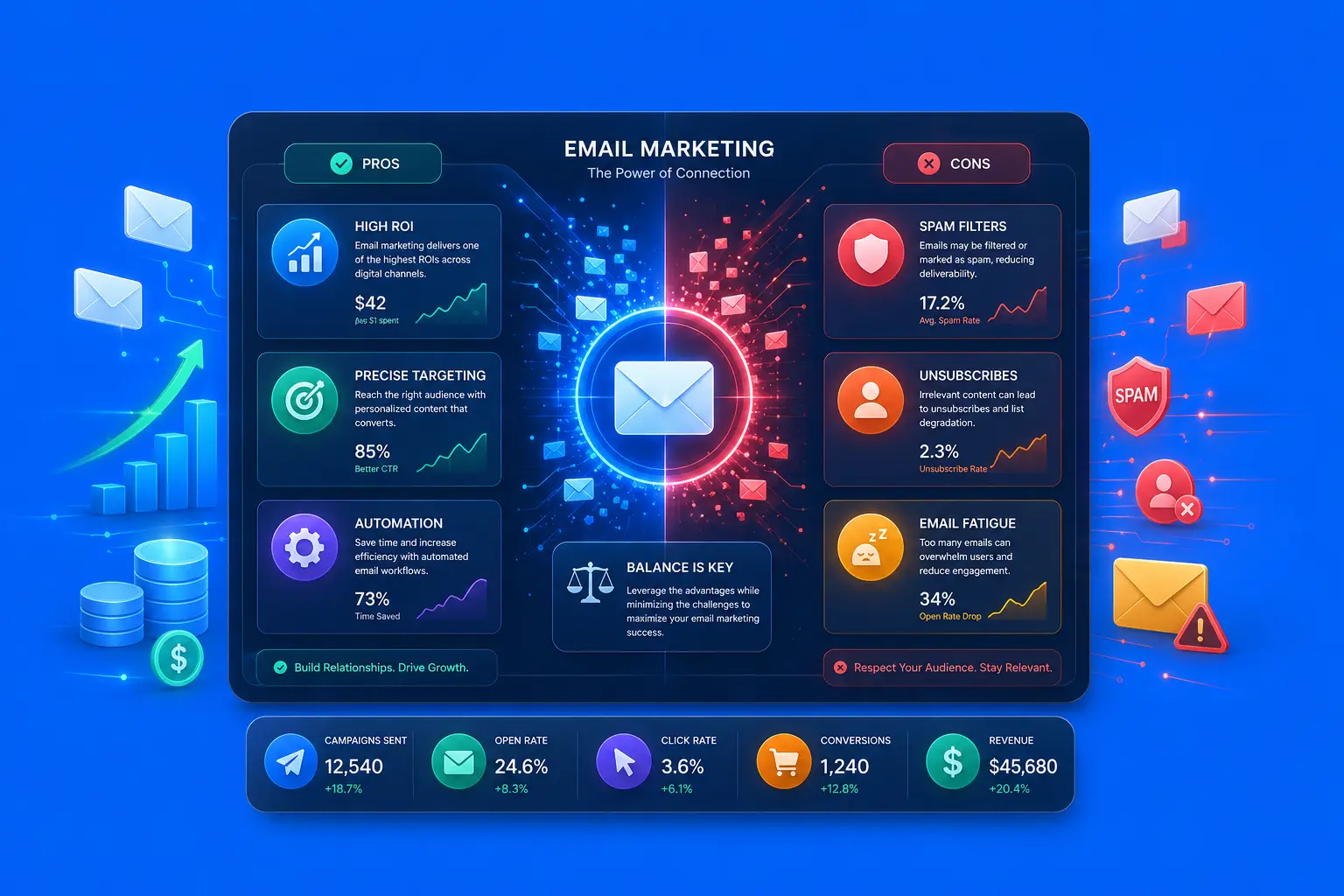
Weighing Email Marketing – Pros, Cons, and Key Stats
Every marketing channel carries its own set of inherent strengths and limitations, and email is no exception. Understanding the full landscape of email marketing's advantages and constraints allows businesses to deploy the channel strategically - capitalizing on its exceptional ROI and direct audience access while proactively addressing deliverability challenges, compliance obligations, and the creative demands required to sustain audience engagement over extended campaign periods.
Advantages supporting scalable business communication growth
Email marketing's core advantages - including its exceptionally high ROI, precise targeting capabilities, complete ownership of the subscriber relationship, and compatibility with virtually every stage of the marketing funnel - make it one of the most versatile and valuable tools available to businesses of all sizes. Unlike paid social or search advertising, the cost of sending emails does not scale linearly with audience size, enabling businesses to communicate with large audiences at a fraction of the cost of comparable paid media campaigns.
Limitations impacting campaign reach and engagement
Despite its many strengths, email marketing faces real limitations that marketers must account for in their strategic planning. List growth requires ongoing investment in lead generation and audience-building activities, while list decay through unsubscribes and inactivity steadily erodes reach over time. Additionally, the increasing sophistication of spam filters, inbox categorization by providers like Gmail, and consumer email fatigue all represent genuine headwinds that require continuous adaptation in content strategy, design, and sending practices.
Balancing benefits and risks for better strategy
The most successful email marketers approach the channel with a balanced perspective that acknowledges both its powerful revenue potential and its operational demands. Building a sustainable email program means investing in permission-based list growth, maintaining rigorous data hygiene, staying current with evolving compliance regulations, and consistently prioritizing subscriber value over short-term promotional volume - a disciplined approach that protects sender reputation and maximizes long-term campaign performance and profitability.
Best suited email marketing use cases
Email marketing's flexibility makes it effective across a wide variety of business models, industries, and organizational scales - but the specific strategies, tools, and investment levels that deliver optimal results vary considerably depending on the nature of the business and the characteristics of its target audience. Understanding which email marketing approaches align best with particular business contexts enables organizations to allocate resources efficiently and deploy campaigns that genuinely move the needle on their most important growth metrics.
Small businesses seeking affordable marketing solutions
For small businesses with limited marketing budgets, email represents an extraordinary opportunity to build a loyal customer base and drive repeat revenue at minimal cost. Platforms like Mailchimp, MailerLite, or ConvertKit offer robust free and low-cost tiers that allow small businesses to implement professional automation, segment their audiences, and track campaign performance without the financial commitment required by enterprise-grade solutions - making email one of the most accessible high-impact marketing channels available.
Enterprises requiring scalable automation and analytics
Large enterprises managing complex, multi-market email programs need platforms that can handle massive sending volumes, sophisticated behavioral automation, multi-language content management, and deep integration with enterprise CRM and data warehouse systems. Solutions like Salesforce Marketing Cloud, Adobe Campaign, and Oracle Responsys are specifically engineered for this operational scale, offering the governance controls, deliverability infrastructure, and advanced analytics that enterprise marketing teams require to manage global campaigns effectively.
E commerce brands driving repeat customer engagement
Email marketing is arguably the single most powerful revenue channel available to e-commerce brands, enabling highly targeted campaigns based on real purchase behavior, browsing history, and predictive analytics. Abandoned cart recovery sequences, post-purchase cross-sell and upsell flows, win-back campaigns for lapsed customers, and personalized product recommendation emails are all proven e-commerce email strategies that directly increase customer lifetime value and transform one-time buyers into loyal repeat customers.
Top strengths of effective email campaigns
When executed with strategic intention and supported by the right data and technology infrastructure, email marketing campaigns deliver a combination of benefits that are simply unmatched by any other digital marketing channel. From its remarkable cost efficiency and precise audience targeting to its independence from third-party algorithm changes and its robust performance measurement capabilities, email's core strengths make it a non-negotiable component of any serious long-term digital marketing strategy.
High return on investment with minimal cost
Email marketing consistently generates some of the highest ROI outcomes among all marketing channels, as Data & Marketing Association and Litmus both report returns exceeding $36 for every dollar invested within this channel. This exceptional efficiency stems from the relatively low cost of sending emails at scale combined with the precision targeting and automation capabilities that ensure each message is delivered to the right person at the right time with content that maximizes the probability of conversion and revenue generation.
Direct audience reach without platform dependency
One of email's most strategically important advantages is that it operates entirely outside of third-party platform ecosystems - meaning businesses own their subscriber lists and can reach their audiences without being subject to algorithmic changes, organic reach limitations, or advertising policy shifts imposed by social media platforms. This independence makes email a uniquely resilient marketing asset that retains its value regardless of what happens in the broader digital advertising landscape or social media environment.
Measurable performance tracking with real time analytics
Email marketing provides marketers with a richness of performance data that is difficult to match in other channels - including precise open rates, click-through rates by link and content block, revenue attribution by campaign and automation flow, subscriber lifetime value analysis, and deliverability health metrics. This granular visibility enables continuous optimization based on actual audience behavior rather than estimated impressions, making email one of the most accountable and measurable investments in the entire digital marketing portfolio.
Common limitations in email marketing strategies
Despite email marketing's formidable strengths, experienced practitioners know that building and sustaining a high-performing email program requires actively managing a set of recurring challenges that can undermine campaign effectiveness if left unaddressed. Spam filtering, audience fatigue, and regulatory compliance pressures collectively demand that email marketers operate with a level of strategic discipline and technical awareness that goes well beyond simply drafting compelling copy and pressing send.
Spam filters affecting inbox placement rates
Modern email spam filters powered by machine learning analyze hundreds of signals simultaneously - including sender reputation, IP and domain history, content quality, engagement patterns, and authentication compliance - to determine whether a given email earns placement in the inbox or gets routed to spam. Marketers who neglect technical email infrastructure, use misleading subject lines, or send to unengaged or unverified lists face increasingly severe deliverability consequences that dramatically reduce their effective reach and campaign performance.
Content fatigue reducing audience interest levels
When subscribers receive too many emails, or emails that consistently fail to deliver genuine value, the result is an increase in list fatigue - characterized by declining open rates, higher unsubscribe rates, and reduced overall engagement that signals audiences have mentally checked out. Preventing content fatigue requires a disciplined content calendar strategy that prioritizes quality over frequency, leverages segmentation to send more targeted messages, and regularly refreshes content formats and value propositions to maintain subscriber interest and attention over time.
Compliance regulations impacting campaign execution
Email marketing is subject to a growing and complex patchwork of international privacy and anti-spam regulations, including GDPR in the European Union, CAN-SPAM in the United States, CASL in Canada, and LGPD in Brazil - each imposing distinct requirements around consent, data storage, unsubscribe mechanisms, and sender identification. Non-compliance carries significant financial and reputational risks, making it essential for email marketers to build regulatory compliance into every aspect of their list management, campaign execution, and data handling practices.
Market comparison of leading email platforms
The email marketing platform market is highly competitive, with dozens of solutions vying for business at every price point and organizational scale. Conducting a structured market comparison across the leading platforms - examining their core feature sets, pricing models, deliverability infrastructure, integration ecosystems, and performance benchmarks - is essential for making an informed technology investment decision that aligns with both current operational requirements and long-term strategic growth objectives.
Feature comparison among top email marketing tools
When comparing top email marketing tools, the features that matter most depend heavily on use case - but key evaluation dimensions consistently include the sophistication of automation workflow builders, the flexibility of segmentation and personalization capabilities, the quality of native integrations with CRM and e-commerce platforms, the comprehensiveness of reporting and attribution analytics, and the reliability of customer support and onboarding resources available to help teams maximize platform value from day one.
Pricing models across different service providers
Email platform pricing models vary considerably across the market, with most providers structuring fees around contact list size, monthly email volume, or a combination of both - while adding charges for advanced features like predictive analytics, dedicated IP addresses, or premium support tiers. Understanding the true total cost of ownership, including implementation costs, training requirements, and integration expenses, is critical to accurately comparing platforms on a cost-adjusted performance basis that reflects actual business impact rather than headline subscription fees.
Performance benchmarks for industry leading platforms
Industry benchmark data from Mailchimp, Campaign Monitor, and Klaviyo consistently shows that average email open rates range from 20 to 40 percent depending on industry vertical, with click-through rates typically falling between 2 and 5 percent across sectors. However, businesses that implement advanced segmentation, behavioral personalization, and rigorous list hygiene practices regularly outperform these industry averages significantly - demonstrating that platform capability combined with strategic execution creates the performance gap between average and exceptional email marketing results.
Email marketing trends and changes in 2026
The email marketing landscape is evolving rapidly in 2026, shaped by accelerating advances in artificial intelligence, heightened consumer expectations for relevance and privacy, and the growing sophistication of email rendering technologies that enable richer in-inbox experiences. Marketers who stay ahead of these emerging trends and proactively adapt their strategies and technology stacks will be best positioned to capture competitive advantage while those who rely on outdated practices will see continued erosion of engagement and performance across their campaigns.
Increased focus on privacy and data protection
Following Apple's Mail Privacy Protection rollout and the continued expansion of global data privacy legislation, email marketers in 2026 are navigating an environment where traditional open-rate tracking has become less reliable and consent-based audience building has become more critical than ever. Brands are responding by investing in zero-party data collection strategies - gathering preference and intent information directly from subscribers through interactive onboarding flows, preference centers, and surveys - to maintain personalization quality without relying on increasingly restricted third-party data signals.
AI driven personalization shaping user experiences
Artificial intelligence is reshaping the personalization capabilities available to email marketers in 2026, enabling genuinely predictive content experiences that adapt dynamically to each individual subscriber based on their full behavioral history, purchase patterns, and predicted future intent. AI tools now allow even mid-market businesses to deploy hyper-personalized email experiences at a scale that was previously only accessible to enterprise organizations with dedicated data science teams, fundamentally raising the bar for what audiences now expect from brands in their inboxes.
Interactive emails enhancing engagement and conversions
Interactive email capabilities - including embedded product carousels, in-email purchase flows, live countdown timers, real-time inventory displays, and interactive surveys - are gaining significant traction in 2026 as email rendering technology matures and support for AMP for Email and HTML5 elements expands across major email clients. These interactive experiences reduce friction in the conversion journey by allowing subscribers to take meaningful actions directly within the email itself, dramatically improving engagement metrics and shortening the path from initial interest to completed purchase.
Building trust through reliable email practices
Trust is the foundation of every successful long-term email marketing relationship, and building it requires a consistent commitment to delivering genuine value, respecting subscriber preferences, and operating with complete transparency about how audience data is collected and used. Businesses that prioritize trust-building in their email practices benefit from stronger engagement rates, longer subscriber lifespans, and a sender reputation that supports superior deliverability - creating a virtuous cycle that compounds the effectiveness of every campaign they send.
Maintaining sender reputation with consistent deliverability
A strong sender reputation is among the most valuable and hardest-to-recover assets in email marketing, built through consistent adherence to deliverability best practices including authenticated sending infrastructure, regular list hygiene to remove inactive and invalid addresses, careful monitoring of spam complaint rates, and gradual IP warming when scaling sending volumes. Marketers who treat sender reputation as a strategic priority - rather than a technical afterthought - enjoy dramatically better inbox placement rates and the compounding business benefits that come with reliable audience reach.
Using authentic content to build audience credibility
Subscribers can quickly identify and disengage from email content that feels manufactured, overly promotional, or misaligned with the authentic voice and values of the brand. Building audience credibility through email requires a genuine commitment to delivering content that educates, entertains, or solves real problems for recipients - whether through expert insights, behind-the-scenes storytelling, customer success stories, or practical how-to guidance that demonstrates genuine expertise and reinforces the brand's authority within its industry.
Compliance with regulations ensuring long term trust
Regulatory compliance in email marketing is not merely a legal obligation - it is a fundamental signal of brand trustworthiness that subscribers increasingly recognize and reward with their continued engagement and loyalty. Brands that implement clear consent collection processes, honor unsubscribe requests promptly, provide transparent privacy policies, and handle subscriber data with genuine care consistently earn higher engagement rates and stronger long-term subscriber relationships than those who treat compliance as a minimum threshold rather than a competitive advantage.
Decision making guide for email strategies
Developing an effective email marketing strategy requires more than selecting a platform and scheduling campaigns - it demands a structured decision-making process that aligns technology choices, content strategies, and budget allocations with clearly defined business objectives, audience behavioral insights, and realistic performance benchmarks. Organizations that approach email strategy with this level of intentionality consistently achieve superior results compared to those who treat it as a tactical execution channel rather than a strategic business growth driver.
Choosing right tools based on business goals
The right email marketing tool for any organization is the one that most effectively supports its specific business goals - whether that means prioritizing e-commerce revenue attribution, B2B lead nurturing automation, transactional email reliability, or multi-language enterprise campaign management. Before evaluating platforms, organizations should clearly document their top three to five business objectives, then assess each platform candidate against those specific criteria rather than relying on generic feature lists or analyst rankings that may not reflect their particular use case requirements.
Aligning campaigns with audience behavior insights
High-performing email campaigns are designed around a deep understanding of how, when, and why target audiences engage with email content - informed by first-party behavioral data from website interactions, past email engagement patterns, purchase history, and customer support touchpoints. Aligning campaign timing, content themes, and call-to-action strategies with actual observed audience behavior - rather than assumed preferences - consistently produces measurably better engagement and conversion outcomes across every industry and business model.
Budget planning for sustainable email growth
Sustainable email marketing growth requires budget planning that accounts for platform costs, list growth investments, content creation resources, testing infrastructure, compliance management, and the personnel or agency costs associated with ongoing campaign strategy and execution. Organizations that treat email marketing as an investment in a long-term business asset - rather than a short-term tactical expense - allocate resources accordingly, building the capabilities and infrastructure needed to continuously compound the channel's contribution to overall business revenue and customer lifetime value.
Taking action for long term email success
The difference between email marketing programs that achieve sustained long-term success and those that plateau or decline lies not in the sophistication of any single campaign, but in the discipline of continuous improvement - systematically testing hypotheses, tracking performance trends, scaling proven strategies, and proactively adapting to changing audience expectations and industry conditions. Organizations committed to this iterative improvement mindset build email programs that grow stronger and more profitable with every passing campaign cycle.
Implementing strategies with continuous performance tracking
Effective email strategy implementation requires establishing a robust performance tracking framework from day one - defining key metrics, setting realistic benchmarks, and creating regular reporting cadences that keep teams informed and accountable. Metrics such as revenue per email, list growth rate, engagement trend lines, deliverability health scores, and unsubscribe rate trajectories collectively provide the early warning signals and optimization opportunities that allow marketers to make informed adjustments before small performance issues compound into significant business problems.
Testing campaigns for consistent improvement results
Systematic A/B and multivariate testing is one of the most reliable levers available to email marketers seeking continuous performance improvement - enabling data-driven decisions about subject line styles, send times, content length, design layouts, personalization approaches, and call-to-action placement that accumulate into significant cumulative gains over successive campaign iterations. The most successful email programs maintain a permanent testing pipeline where every major campaign includes at least one structured test designed to generate actionable learnings that inform future strategy decisions.
Scaling email marketing for future business growth
Scaling an email marketing program successfully requires building the right foundations before growth - including a clean, well-segmented subscriber database, documented automation workflows, a content production system capable of supporting increased sending frequency, and a technology infrastructure that can handle higher volumes without compromising deliverability or personalization quality. Organizations that invest in these foundational capabilities early position themselves to scale efficiently and profitably as their businesses grow, capturing increasing returns from the email channel at every stage of their expansion.
Conclusion
Email marketing is not just a tool - it is a long-term business asset. In a world where paid ads are getting more expensive and social media reach is shrinking, your email list is something you truly own. No algorithm can take it away.
The businesses that win with email are not necessarily the ones spending the most. They are the ones being consistent, genuine, and strategic. They segment their audiences, automate thoughtfully, test regularly, and always prioritize subscriber value over short-term gains.
As 2026 brings AI-powered personalization, interactive emails, and stronger privacy expectations, the bar is rising. But so is the opportunity. Brands that adapt early and build trust through ethical, value-driven email practices will enjoy compounding returns year after year.
Start where you are. Use the tools that fit your budget. Focus on permission-based list building, clean data, and relevant content. Track your numbers and improve with every campaign. Email marketing rewards patience and discipline - and the results, when done right, speak for themselves.
FAQs
1. What is a strong open rate for email campaigns?
Typical benchmarks fall between 20% and 40% based on your industry. Online retail and B2B sectors often show noticeable fluctuations. Crossing the 25% mark generally indicates solid performance. Prioritize steady growth instead of aiming for one specific target.
2. How often should I email my subscribers?
There is no single fixed rule. Many brands perform well sending 1 to 4 emails monthly. What matters most is regularity and meaningful content. Over-emailing without value increases unsubscribes. Infrequent emails cause people to lose interest.
3. What does email deliverability mean and why is it important?
Deliverability describes whether your messages reach the inbox instead of spam folders. Even well-crafted emails fail if they remain unseen. Strong deliverability depends on authentication (SPF, DKIM, DMARC), a verified list, and a trusted sender profile.
4. Which email tool suits small businesses best?
Mailchimp, MailerLite, and ConvertKit remain widely used among small businesses. They provide budget-friendly plans with automation, templates, and reporting features. The right option depends on your audience size, objectives, and business model type.
5. What is email segmentation and is it necessary?
Segmentation involves dividing your audience into groups using behavior, demographics, purchase data, or preferences. Yes, it is essential. Broadcasting identical emails to everyone reduces effectiveness. Targeted campaigns drive better opens, clicks, and conversions.
6. What are effective ways to expand my email list organically?
Provide something useful in return for signups such as guides, discounts, checklists, or webinars. Add opt-in forms across your website, social channels, and landing pages. Always gain clear consent and avoid purchased lists to maintain trust and deliverability.
7. What email marketing mistakes should I avoid?
Frequent errors include using outdated or unverified contacts, ignoring mobile design, writing misleading subject lines, skipping segmentation, avoiding A/B testing, and neglecting spam complaints. Correcting these issues can quickly boost overall performance.
8. Is email marketing still effective in 2026?
Yes, it remains highly effective. Email consistently generates strong ROI, often estimated between $36 and $42 per dollar invested. With AI-driven personalization, interactive formats, and direct audience ownership, its impact continues to grow in 2026.
Tags: Email campaign performance, Sender reputation management, Inbox placement strategies, Email list hygiene, Omnichannel marketing integration, Behavioral email targeting, Email marketing analytics
Table Of Contents
- Email marketing challenges affecting business growth
- Understanding importance of email marketing today
- Proven email marketing strategies for success
- Advanced solutions for scalable email campaigns
- Email marketing tools and methods comparison
- Email marketing pros and cons overview
- Best suited email marketing use cases
- Top strengths of effective email campaigns
- Common limitations in email marketing strategies
- Market comparison of leading email platforms
- Email marketing trends and changes in 2026
- Building trust through reliable email practices
- Decision making guide for email strategies
- Taking action for long term email success
- Conclusion
- FAQs