
Email Marketing vs Google & Meta Ads: Which Is Better?
.png)
Table Of Contents
- Engage, Convert, Retain, Repeat.
- How Do Google Ads and Meta Ads Drive Instant Traffic and Paid Conversions?
- Email builds trust, loyalty, and lasting profitable relationships.
- Ads Instantly Reach Millions, Generating Leads and Visibility.
- When Budget's Tight, Email Wins Always.
- Context, Intent, Audience, Reach, Awareness, Scale.
- Whom Should Businesses Target with Email Marketing vs Google and Meta Ads?
- Right Industry Makes Email Marketing Shine
- Meta Wins Awareness, Google Captures Buyers
- Track CPM, CTR, ROI - Email Wins.
- Which Channel Gives Better Results for B2B Lead Generation?
- It Depends On Your Budget and Audience.
- Unified Channels Amplify Reach, Conversions, and ROI.
- How to Build a Full-Funnel Digital Marketing Strategy Using Email, Google Ads, and Meta Ads
- Common Mistakes to Avoid in Email Marketing vs Paid Ads Campaigns
- Conclusion
- FAQs
Which Channel Drives Better ROI in 2026?
If you're trying to decide whether email marketing is better than Google Ads or Meta Ads, the honest answer is: it depends on what your business needs right now. Google Ads can capture high-intent buyers the moment they search. Meta Ads can put your offer in front of new audiences fast. Email marketing, however, is where long-term profitability often happens - through lead nurturing, repeat purchases, retention, and stronger customer lifetime value. That's why in 2026, the smartest businesses aren't choosing one over the other. They're using paid ads to attract attention and email marketing to turn that attention into loyal, repeat revenue.
| Factor | Email Marketing | Google Ads | Meta Ads | Best For | Funnel Stage |
| Best For | Retention & repeat revenue | High-intent leads | Brand awareness & discovery | - | - |
| Avg. ROI | $36–$42 per $1 spent | Varies by CPC/bid | Varies by CPM/CPA | - | - |
| Audience Ownership | Fully owned list | Rented platform | Rented platform | - | - |
| Speed to Results | Slow build, long payoff | Immediate traffic | Immediate impressions | - | - |
| Cost Structure | Low per-send cost | CPC-based | CPM / CPA-based | - | - |
| Best Funnel Stage | Middle & bottom | Bottom (intent) | Top & middle | - | - |
| Targeting Method | Subscriber segmentation | Search intent & keywords | Interests & behaviour | - | - |
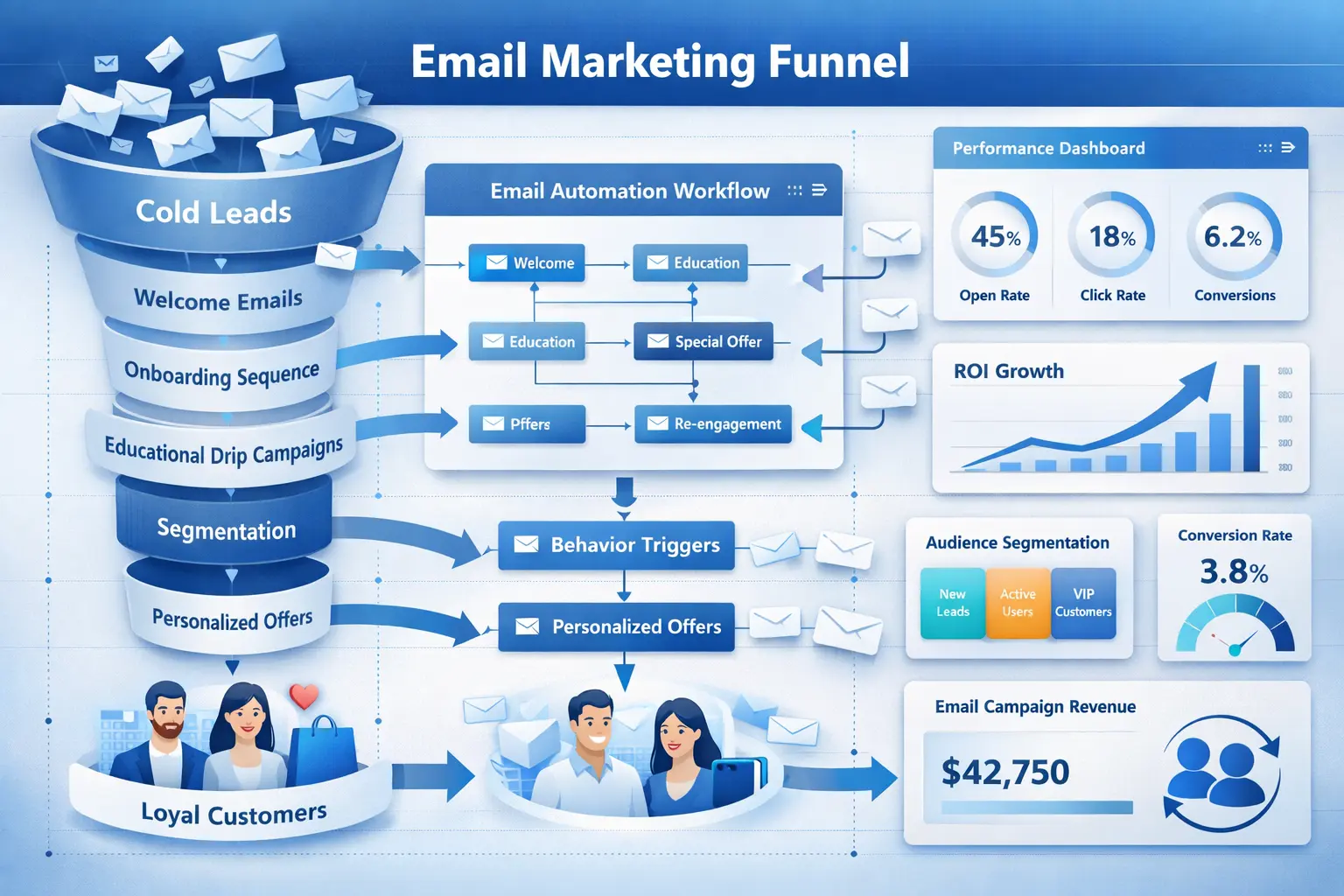
Engage, Convert, Retain, Repeat.
Email marketing works best as a nurturing tool for your leads - using automated sequences, segmentation, and behaviourally triggered campaigns to move subscribers along the buying journey. It consistently delivers one of the highest ROIs of any digital marketing channel available to businesses of any size.
Building Trust Through Automated Email Sequences
Welcome flows, onboarding sequences, and educational drip campaigns build credibility before a purchase is ever made. Trust compounds gradually, improving open rates and conversion rates over time.
Using Segmentation to Improve Repeat Purchase Rates
Segmenting subscribers by purchase history, engagement level, or product interest lets you send relevant content that converts. Industry data shows highly segmented campaigns drive significantly more revenue than generic blasts - making list segmentation one of the highest-leverage activities in email marketing.
Turning Cold Leads Into Loyal Customers With Drip Campaigns
A drip campaign is an automated sequence that nurtures cold leads with value-first content across multiple touchpoints. Instead of pushing a sales offer too early, it builds trust, educates the subscriber, and keeps your brand top of mind. By the time a discount or offer arrives, the subscriber already feels familiar with your brand - making them far more likely to convert and increasing long-term customer lifetime value.
How Do Google Ads and Meta Ads Drive Instant Traffic and Paid Conversions?
The biggest advantage of paid advertising is speed. Paid platforms can put your offer in front of large, targeted audiences within hours of campaign launch - making them ideal for businesses that need measurable results quickly.
Capturing High-Intent Buyers With Google Search Ads
Google Search Ads target users actively searching for solutions, placing your business at the top of results when purchase intent is highest. This intent-based positioning typically delivers strong conversion rates compared to interruption-based formats.
Using Meta Ads to Create Demand and Social Discovery
Meta Ads on Facebook and Instagram reach users based on interests, demographics, and lookalike audiences. They create demand rather than capture it - making them powerful for brand awareness, product discovery, and impulse-purchase categories.
Speed of Paid Traffic vs Organic Email Relationship Building
Paid ads deliver speed, but speed alone doesn't build loyalty. Email marketing is a slower but highly compounding long-term asset. Businesses with tight launch timelines benefit most from ads; those focused on long-term profitability scale better through email.
Email builds trust, loyalty, and lasting profitable relationships.
Lower Acquisition Cost After the First Conversion
Once a subscriber joins your list, the cost to re-engage them is a fraction of paid ad CPCs. Repeat customers typically spend significantly more than new customers, making email the most cost-efficient retention channel available.
Higher Lifetime Value Through Repeat Engagement
Email campaigns for upsells, cross-sells, and loyalty rewards steadily increase customer lifetime value. Post-purchase flows and anniversary emails keep your brand top of mind between buying cycles - without additional ad spend.
Owned Audience Advantage Over Rented Ad Platforms
Your email list is an asset your business fully owns. Algorithm changes, platform policy updates, or rising ad costs on Google or Meta don't affect your ability to reach subscribers directly in their inbox. That ownership is the foundation of first-party data marketing - one of the most important advantages in a privacy-first 2026 landscape.
Ads Instantly Reach Millions, Generating Leads and Visibility.
Reaching New Audiences at Scale in Less Time
Paid campaigns can reach millions of targeted users within days. For new brands, product launches, or seasonal promotions with defined windows, no organic channel matches the speed and scale of Google or Meta advertising. The key is knowing when speed matters more than cost efficiency.
Fast Testing of Creatives, Offers, and Landing Pages
A/B testing ad copy, visuals, and landing pages in a paid environment produces statistically significant data in days rather than months. This testing velocity accelerates conversion rate optimisation across all marketing channels - and feeds insights back into your email strategy.
Expanding Brand Visibility Beyond Existing Subscribers
Email only reaches your current list. Paid ads expand visibility to cold audiences, competitor customers, and interest-based segments that would never have discovered your brand organically. For lifecycle marketing to work at scale, you need paid acquisition to keep feeding the top of the funnel.
When Budget's Tight, Email Wins Always.
A warm, engaged list is a ready-to-activate revenue channel. If your open rates are healthy and your list is segmented, email campaigns will almost always outperform equivalent ad spend on ROI.
When Retention Matters More Than First-Time Reach
E-commerce stores with high repeat-purchase potential, SaaS businesses reducing churn, and subscription brands extending customer lifecycles should prioritise email over paid acquisition. In these cases, customer acquisition cost (CAC) is already covered - email is how you maximise return on that investment.
When Budget Is Tight but Repeat Sales Are a Priority
Email marketing platforms cost a fraction of paid ad budgets and scale without linear cost increases. For lean teams focused on profitable growth, email delivers more consistent returns per pound or dollar spent.
Context, Intent, Audience, Reach, Awareness, Scale.
When You Need Immediate Leads or Sales This Week
Paid search and social deliver results on day one. If your business needs leads, sign-ups, or sales within a short window, Google and Meta campaigns are the fastest path to measurable conversions.
When Launching a New Product With No Email List
Without a subscriber base, paid ads are the primary acquisition channel. A launch strategy using Meta Ads for awareness and Google Ads for intent capture can build initial traction and simultaneously grow your email list for long-term nurturing.
When Retargeting Website Visitors Across Multiple Channels
Google Display and Meta retargeting campaigns re-engage users who visited your site but didn't convert. Combined with email remarketing and omnichannel attribution, multi-touch retargeting significantly increases overall conversion rates.
Whom Should Businesses Target with Email Marketing vs Google and Meta Ads?
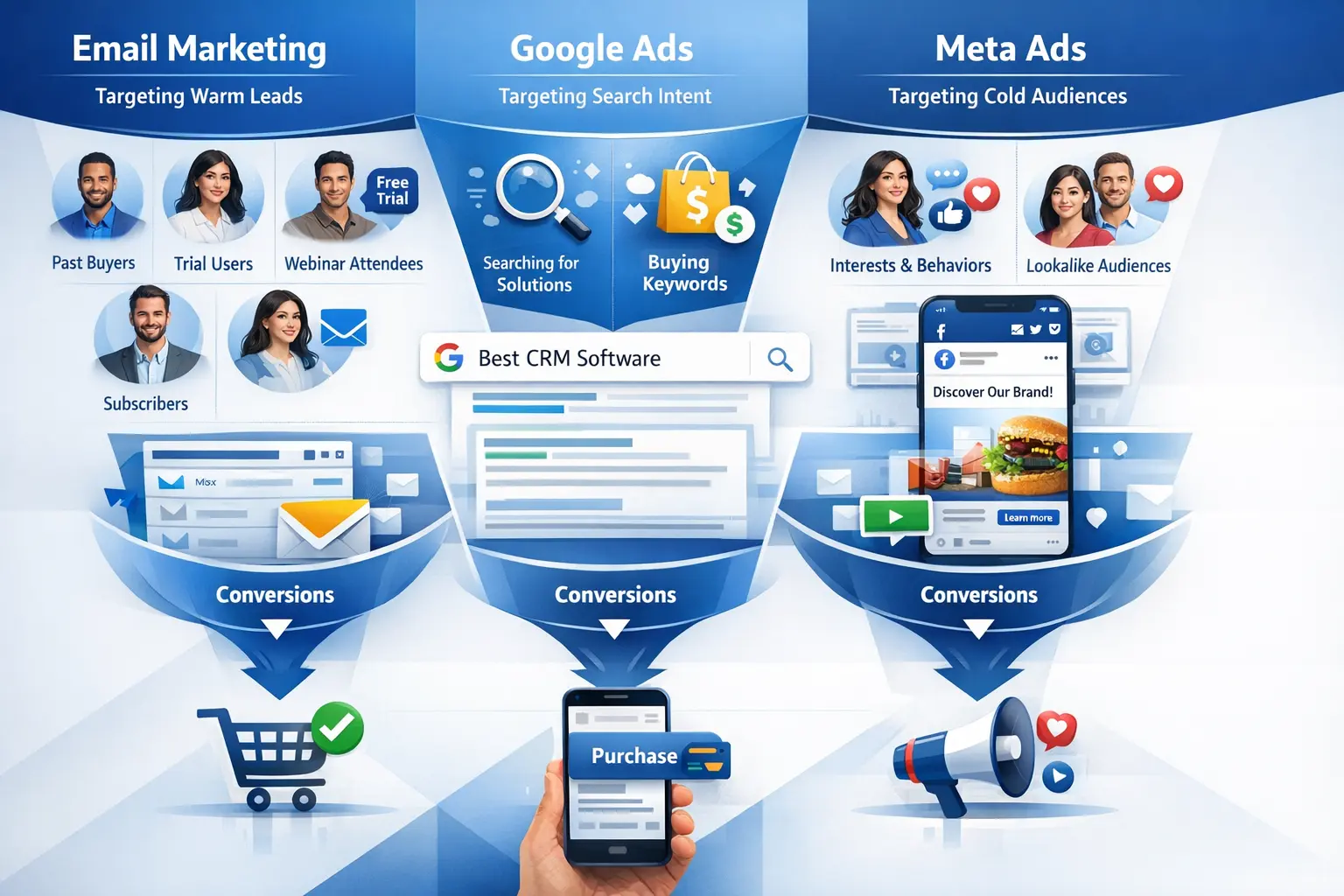
Existing Customers and Warm Leads for Email Campaigns
Email is ideal for people who already know your brand: past buyers, trial users, webinar attendees, and opt-in subscribers. These warm audiences convert at significantly higher rates than cold traffic from paid ads.
Intent-Based Search Users Through Google Ads
Google Ads target users by keyword intent, placing your offer in front of people actively searching for what you sell. This makes it highly effective for service businesses, B2B SaaS, and high-consideration purchases where purchase intent is explicit.
Interest and Behaviour Audiences Through Meta Ads
Meta's targeting uses behavioural data, interests, and lookalike modelling to reach cold audiences likely to be interested in your product. It's most effective for consumer brands, visual products, and impulse-purchase categories.
Right Industry Makes Email Marketing Shine
E-commerce Retention Through Offers and Cart Recovery
Abandoned cart emails recover a meaningful percentage of lost revenue. Post-purchase flows, VIP loyalty campaigns, and win-back sequences make email the backbone of profitable e-commerce retention. In our experience across retention-led campaigns, email consistently produces stronger repeat-purchase efficiency than paid social once a list is actively segmented and automated.
SaaS Lead Nurturing With Onboarding and Upsell Emails
SaaS companies use onboarding emails to reduce churn, feature announcement emails to drive upgrades, and milestone messages to increase product stickiness. Email directly supports MRR growth and reduces acquisition dependency over time.
Travel and Local Promotions Through Seasonal Campaigns
Travel brands and local businesses drive bookings and foot traffic through timely promotional emails tied to holidays, seasons, or local events. Personalised discount emails to previous customers consistently outperform cold ad campaigns in cost-per-booking metrics.
Meta Wins Awareness, Google Captures Buyers
Google Search for High-Intent Conversion Campaigns
Legal, healthcare, home services, finance, and SaaS categories with high purchase intent consistently see strong ROI from Google Search Ads when campaigns are properly structured with tight keyword groups and optimised landing pages.
Meta Ads for Visual Products and Impulse Buying
Fashion, beauty, food, fitness, and home décor brands generate significant revenue from Meta's visual ad formats. Short-form video and carousel ads drive product discovery and impulse conversions at scale.
Display and Remarketing for Multi-Touch Attribution
Display ads and remarketing campaigns reinforce brand recall across the buyer journey. With proper blended ROAS attribution - rather than last-click models - they contribute meaningfully to conversions that began with email or organic search.
Track CPM, CTR, ROI - Email Wins.
Cost Per Click vs Cost Per Email Delivered
Average Google Search CPCs range from $1 to $10 or higher in competitive niches. Email cost per send is often fractions of a cent - making email 10–100× cheaper per contact reached once your list is established.
Measuring Open Rate, CTR, and Conversion Side by Side
Email average open rates sit between 20–35% for engaged lists. Display ad CTRs average around 0.1%. Search ad CTRs range from 3–10%. For engaged subscribers, email outperforms every paid channel on click-to-conversion ratio.
Tracking Revenue Attribution Across Both Channels
Use UTM parameters, attribution windows, and CRM integration to track which channel sourced and closed revenue. Avoid last-click attribution errors that undervalue the role email plays in repeat purchase journeys. Cookieless attribution and incrementality testing are increasingly important for accuracy in 2026.
Which Channel Gives Better Results for B2B Lead Generation?
Email Outreach for Account-Based B2B Nurturing
Account-based email sequences that deliver case studies, ROI data, and social proof to specific decision-makers are a cost-effective way to move complex B2B deals through long sales cycles.
Google Ads for High-Intent Service and SaaS Queries
B2B buyers searching for software, consulting, or professional services on Google have high purchase intent. Targeted search campaigns generate qualified leads that convert well with proper email follow-up.
Meta Lead Forms for Awareness-Stage B2B Campaigns
Meta's lead generation forms work well for top-of-funnel B2B awareness - particularly for webinar sign-ups, downloadable guides, and event registrations. They're most effective when paired with an immediate email nurture sequence.
It Depends On Your Budget and Audience.
Email Flows for Abandoned Cart and Repeat Orders
For existing customers, email wins. Abandoned cart, browse abandonment, and replenishment flows generate consistent incremental revenue with minimal ongoing management once properly configured.
Google Shopping Ads for Purchase-Ready Buyers
Google Shopping Ads show product images, prices, and reviews to users already searching for items to buy. For e-commerce stores with competitive pricing and quality creative, Shopping campaigns drive strong purchase-intent traffic.
Meta Retargeting for Product Discovery and Upsells
Dynamic product ads on Meta retarget users who viewed products but didn't purchase, and introduce complementary items to existing customers. Combined with email upsell sequences, they form a powerful post-purchase revenue loop.
Unified Channels Amplify Reach, Conversions, and ROI.
Turning Paid Traffic Into Owned Email Subscribers
Use Meta and Google Ads to drive traffic to lead magnet landing pages. Every subscriber acquired through paid traffic becomes a long-term, zero-incremental-cost owned media asset - exactly the kind of first-party data marketing that outperforms rented audiences over time.
Retargeting Email Clickers With Smarter Ad Campaigns
Upload email lists to Meta and Google as custom audiences to retarget engaged subscribers who clicked but didn't convert. This cross-channel retargeting dramatically improves ROAS and overall campaign efficiency.
Improving ROAS With Full-Funnel Audience Sync
Sync your CRM and email platform with Google and Meta's audience tools. Exclude existing customers from acquisition campaigns, create lookalikes from your best buyers, and match lapsed subscribers to win-back ad sets. This full-funnel sync reduces wasted spend and improves blended ROAS across every channel.
How to Build a Full-Funnel Digital Marketing Strategy Using Email, Google Ads, and Meta Ads
Top-of-Funnel: Awareness With Search and Social Ads
Run Google Display and Meta awareness campaigns targeting cold audiences. Focus on brand recall, value proposition, and lead magnet offers that capture email addresses for downstream nurturing.
Middle-Funnel: Nurturing With Lead Magnets and Emails
Once prospects are on your list, deliver educational content, comparison guides, and social proof via email. This middle-funnel nurturing shortens sales cycles and increases the quality of inbound demo requests or checkout sessions.
Bottom-Funnel: Conversions With Retargeting and Offers
Deploy retargeting ads and promotional emails simultaneously for bottom-funnel audiences. Coordinated offers across both channels reinforce buying intent and remove conversion barriers at the moment they matter most.
Common Mistakes to Avoid in Email Marketing vs Paid Ads Campaigns
Ignoring Audience Segmentation and Intent Signals
Sending the same email to your entire list - or targeting the same ad audience regardless of funnel stage - wastes budget and depresses engagement. Segment rigorously by behaviour, purchase history, and intent signals.
Sending Traffic to Weak Landing Pages or Forms
Paid traffic is wasted if landing pages are slow, unclear, or misaligned with the ad message. Email clicks convert poorly if the destination page lacks a focused CTA. Treat landing page quality as seriously as campaign targeting.
Failing to Track Attribution and Revenue Metrics
Without proper UTM tagging, revenue attribution, and CRM integration, you can't accurately determine which channel drives profitable growth. Invest in attribution before scaling either channel's budget.
| Channel | Best When… | Key Strength |
| Email Marketing | You have a warm list, want repeat sales, or are focused on retention and lifecycle marketing | Owned audience, highest ROI, compounding returns |
| Google & Meta Ads | You need fast traffic, new-audience reach, or are launching a new product with no list | Speed, scale, new customer acquisition at volume |
| Combined Strategy | You want scalable, sustainable growth that converts new audiences into loyal, repeat customers | Full-funnel efficiency, owned media + paid reach working together |
Conclusion
Email marketing and paid ads aren't rivals - they're complementary engines of growth. Email delivers unmatched ROI on existing audiences; Google and Meta Ads bring new audiences in at scale. The businesses growing most profitably in 2026 use paid channels to build their list and email to extract long-term value from every subscriber they earn.
The smartest move isn't picking a winner. It's understanding what each channel does best - and building a full-funnel strategy that makes them work together.
FAQs
1. Is email marketing cheaper than Google Ads?
Yes. Email marketing typically costs $0.001–$0.01 per send, while Google Ads CPCs range from $1 to $10+ in competitive industries. Email is significantly more cost-efficient for audiences already on your list.
2. Which channel has better ROI: email or paid advertising?
Email marketing averages $36–$42 return per $1 spent, making it one of the highest-ROI digital channels. Paid ads ROI varies widely by industry, targeting quality, and landing page performance - making them harder to predict but faster to test.
3. Can small businesses use both email and paid ads?
Absolutely. A common approach is to run low-budget Meta lead ads to grow an email list, then use email to nurture and convert those subscribers at near-zero marginal cost. This blended approach works even with modest budgets.
4. How do I track which channel drives more revenue?
Use UTM parameters on all links, connect your email platform to Google Analytics, and configure multi-touch attribution in your CRM to understand each channel's contribution to closed revenue. Avoid last-click models - they typically undervalue email's role in the customer journey.
5. What 2026-specific factors should I consider?
First-party data strategy is now critical as third-party cookies phase out. Owned audiences - your email list - become more valuable as privacy-safe acquisition channels. Blended ROAS, incrementality testing, and lifecycle marketing are the frameworks leading brands are using to measure and scale profitably.
Tags: Paid ads vs email campaigns, Customer retention marketing strategy, Lead nurturing with email automation, First party data marketing 2026, Lifecycle marketing for businesses, Google Search Ads for lead generation, Meta Ads for brand awareness, Omnichannel marketing ROI, Blended ROAS strategy 2026, Email and paid ads integration
Table Of Contents
- Engage, Convert, Retain, Repeat.
- How Do Google Ads and Meta Ads Drive Instant Traffic and Paid Conversions?
- Email builds trust, loyalty, and lasting profitable relationships.
- Ads Instantly Reach Millions, Generating Leads and Visibility.
- When Budget's Tight, Email Wins Always.
- Context, Intent, Audience, Reach, Awareness, Scale.
- Whom Should Businesses Target with Email Marketing vs Google and Meta Ads?
- Right Industry Makes Email Marketing Shine
- Meta Wins Awareness, Google Captures Buyers
- Track CPM, CTR, ROI - Email Wins.
- Which Channel Gives Better Results for B2B Lead Generation?
- It Depends On Your Budget and Audience.
- Unified Channels Amplify Reach, Conversions, and ROI.
- How to Build a Full-Funnel Digital Marketing Strategy Using Email, Google Ads, and Meta Ads
- Common Mistakes to Avoid in Email Marketing vs Paid Ads Campaigns
- Conclusion
- FAQs